A senior RevOps and operations team — without building the department yet.
Keep your systems, dashboards, AI workflows, and revenue operations moving — managed monthly by the same senior team that built them. Start with a build, stay on a retainer.
The argument
A growing company eventually needs RevOps, operations, data, AI, CRM, and integration roles in-house. OpsPal gives the owner that senior cross-functional capability now — before they're ready to hire and manage the whole department. The revenue-operations and Salesforce layer is led by a Salesforce-certified RevOps leader who has built and led revenue systems at enterprise scale across multiple M&A integrations. You get the operating team without the org chart, the payroll, or the management overhead.
Before you hire five roles, build the operating layer.
The internal hiring path
- RevOps lead
- Operations manager
- Data / reporting analyst
- Automation / AI builder
- Systems / integration engineer
Roughly $585,000–$870,000 per year, fully loaded.
The OpsPal path
- CRO/COO-level operator
- Salesforce / integration engineer
- Infrastructure / product architect
- AI + automation workflows
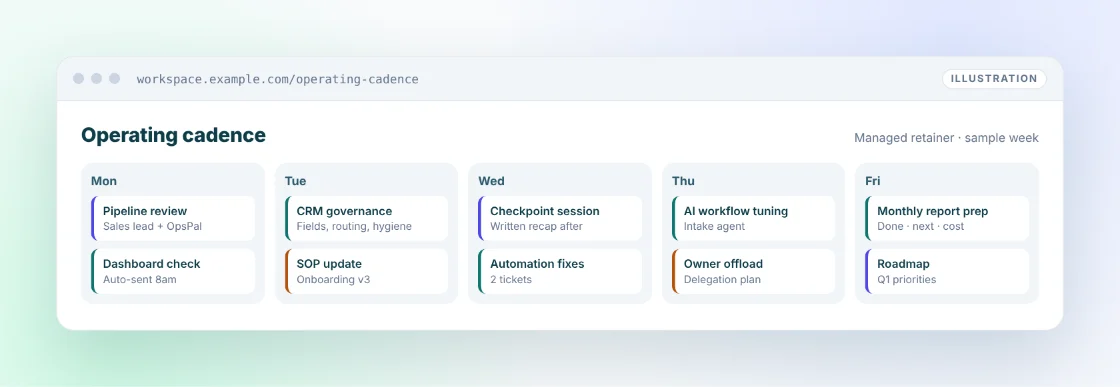
- Monthly operating cadence
A senior cross-functional team — from $3,600/mo.
Estimate based on 2025–2026 US salary data (Glassdoor, Salary.com, U.S. Bureau of Labor Statistics) for five roles — RevOps lead, operations manager, data analyst, automation engineer, and Salesforce/integration developer — at a small-to-mid-sized business, applying a 1.3× fully-loaded cost multiplier covering benefits, payroll taxes, and overhead (Hadzima/MIT formula; BLS Employer Costs for Employee Compensation). Ranges are planning estimates, not quotes.
What the retainer includes
- Monthly RevOps leadership
- CRM governance
- Dashboard review
- Process improvement
- AI workflow management
- Automation maintenance
- Infrastructure / vendor management
- SOP updates
- Sales / marketing-ops alignment
- People-systems advisory
- Owner-offload planning
- Team training
- Quarterly roadmap
What this improves
- Monthly systems improvements without a full-time hire
- Dashboards reviewed and kept current
- CRM governed and maintained
- Automations monitored
- AI workflows improved over time
- Owner has an operating partner
Team & role design
Part of the operating layer most firms ignore: organizational design, role clarity, and team-fit intelligence — informed by the lens we built into Kinaura. This is not therapy, HR compliance, or psychometric diagnosis. It's making sure the right people own the right work.
- The owner can't delegate.
- The team is misaligned.
- Meetings waste time.
- Roles overlap.
- Sales/ops handoffs fail.
- The wrong person owns the wrong work.
The retainer ladder
Scoped by operating load, meeting cadence, and systems responsibility — capacity-capped, not unlimited.
Care Plan Managed Infrastructure
For systems, apps, and websites OpsPal built. Hosting and uptime monitoring, minor fixes and small changes, dependency and security updates, and a monthly status report. Protect the investment — the team that built it keeps it running.
Managed RevOps
Operating cadence plus systems responsibility: scheduled checkpoint sessions, a prioritized backlog, dashboards and reporting maintained, automation and AI workflows monitored and improved — all documented in a shared Confluence workspace. Scoped by operating load, meeting cadence, and systems responsibility.
Embedded AI Engineer The forward-deployed model
A senior AI engineer embedded in your business: deploys AI workflows against your real data, integrates them with your CRM, email, and documents, monitors accuracy, and trains your team to run them. Usually paired with or following an AI Operations build. How it works →
Strategic Operating Partner
The embedded model: audit → roadmap → implementation → ongoing direction. For owners preparing to scale or exit, and for acquirers and operators who need an outside ops team driving the operating layer. Everything in Managed RevOps, plus a strategic planning cadence and cross-functional ownership.
What every retainer includes
- A named account lead and an assigned engineer — both client-facing. The people who scope the work are the people who do it.
- A shared Confluence workspace: activity logging, living documentation, decisions, and change orders — visible to you, amendable, auditable.
- Written recaps after every checkpoint session.
- Monthly reporting on what was done, what's next, and what it costs.
Proof we run systems long-term
AI operations · RevOps · Named case
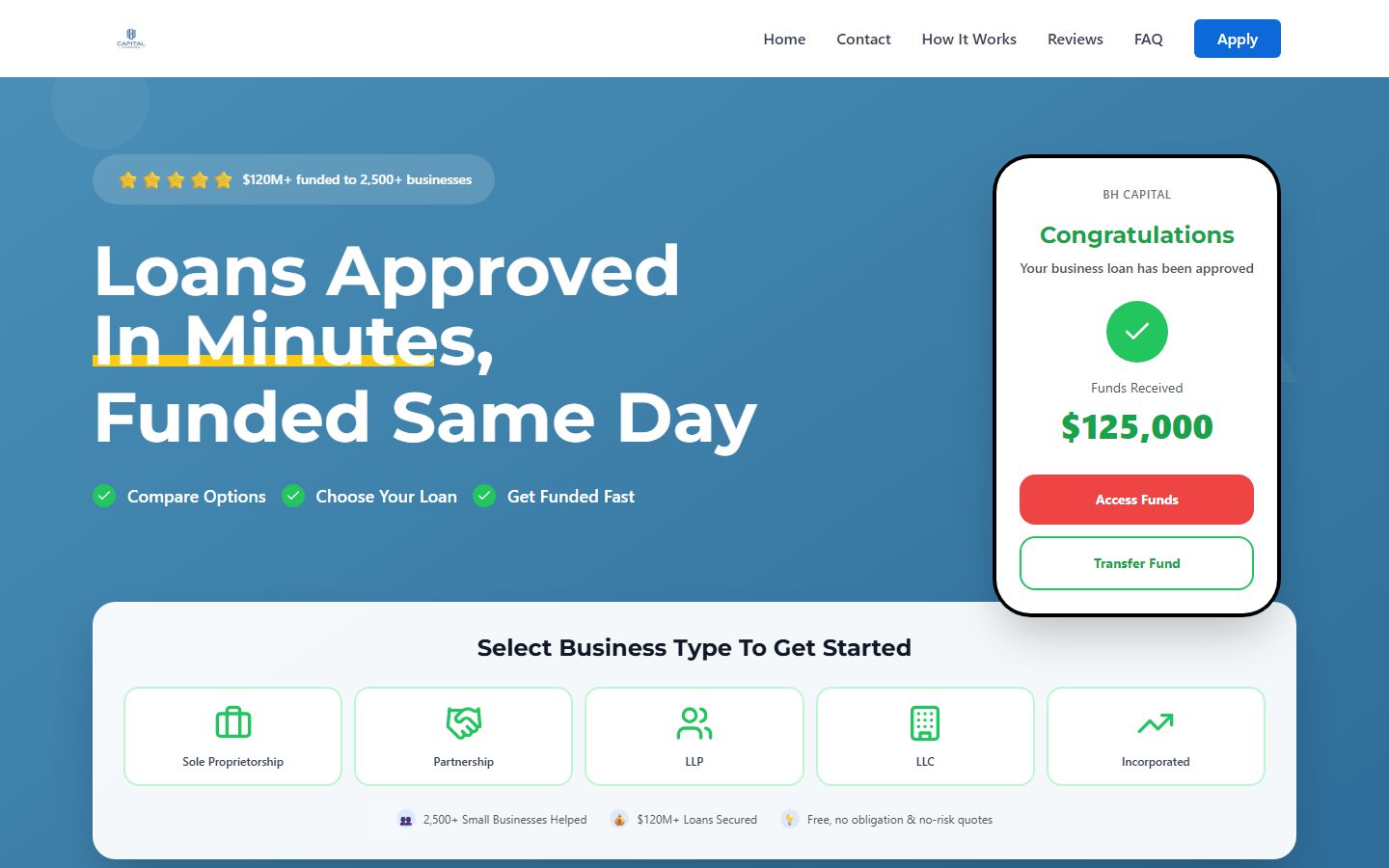
BH Capital Funding: built, then kept running
We built the AI underwriting engine, then stayed on for ongoing optimization and RevOps integration, the same build-then-manage motion the retainer is built around. 30 → 5 minutes per file, approvals in 2–3 hours, about 35% fewer declines.
Daniel Speiss co-founded BH Capital Funding. Metrics are operator-reported.

Fractional ops · Website → Lead Engine · Named case
Soko Healthcare: from a website build to the operating team
A nurse-founded direct-hire recruiter in South Florida. We rebuilt the site as the lead engine and wrote the sales operating system for the firm’s first business-development hire, then stayed on as its outside operating team: process written down, decisions in one record, and a measurement loop on what brings facilities and nurses in.
Fractional ops: questions answered
Do you offer retainers, and are they required?
Yes, we offer monthly retainers, and no, they are not required. Most clients start with a one-time, scoped build they fully own, then choose a retainer afterward. That is our model: start with a build, stay on a retainer. The second half is optional, and you decide only after you have seen the work.
A retainer is for businesses that want an outside senior team to keep their systems, dashboards, AI workflows, and revenue operations running and improving after launch. It starts from $3,600/month and is scoped by operating load, meeting cadence, and how much systems responsibility you want us to hold. Plenty of clients take a finished system and run it in-house instead. See /fractional-ops/ for the full picture and /pricing/ for how it sits next to project work, or book a call at /book/ .
What does a managed RevOps retainer include?
Depending on your tier, the retainer covers the ongoing operating layer a growing business would otherwise hire several people to run. That includes monthly RevOps leadership, CRM governance, dashboard review, process improvement, AI workflow management, automation maintenance, and infrastructure or vendor management. It also covers SOP updates, sales and marketing-ops alignment, role design, owner-offload planning, team training, and a quarterly roadmap.
The idea is to keep what we built healthy and getting better, not to hand you a project and walk away. Larger net-new builds are usually scoped as their own Build Sprints rather than absorbed into the monthly fee, so the retainer stays focused on running and improving what exists. The exact mix is scoped to your business on a call. See the full inclusion list at /fractional-ops/ , and how builds and retainers fit together at /pricing/ .
How do the Care Plan, Managed RevOps, and Strategic Operating Partner tiers differ?
They are three levels of involvement. The Care Plan ($500–$1,500/month) is for systems, apps, and websites OpsPal built: hosting and uptime monitoring, minor fixes and small changes, dependency and security updates, and a monthly status report — the team that built it keeps it running. Managed RevOps (from $3,600/month) adds operating cadence and systems responsibility: scheduled checkpoint sessions, a prioritized backlog, dashboards and reporting maintained, and automation and AI workflows monitored and improved, documented in a shared Confluence workspace. Strategic Operating Partner (from $6,000/month) is the embedded model — audit, roadmap, implementation, and ongoing direction — for owners preparing to scale or exit, and for acquirers who need an outside ops team driving the operating layer.
All three are capacity-capped rather than unlimited, which is what keeps delivery reliable, and every retainer includes a named account lead and assigned engineer, written checkpoint recaps, and monthly reporting. We recommend the lightest tier that actually fits, then adjust as your needs change. Full detail lives at /fractional-ops/ ; book at /book/ to size it.
Are the tiers unlimited, or is there a cap on hours?
They are capacity-capped, not unlimited, and we say so on purpose. Each tier is scoped by hours, meeting cadence, and systems responsibility, so we know exactly what we have committed to and can deliver it reliably. Unlimited retainers tend to mean either padded pricing or quietly degrading service when everyone is busy. We would rather be honest about capacity than overpromise.
If your needs grow past your current tier, we talk about moving up rather than silently stretching thin. That cap is what lets us keep response and delivery dependable for every client, since we are a senior studio that protects quality by not overbooking. You will always know what is in scope and what would be a separate build or add-on. Full detail lives at /fractional-ops/ .
What happens after a build launches?
After the build ships, you have a real choice. Many clients move to a managed retainer, from $3,600/month, so the same senior team keeps operating, improving, and supporting the systems as the business changes. Retainers are scoped by operating load, meeting cadence, and how much systems responsibility you want us to carry.
If you would rather take it fully in-house, you can. Every build ships with written documentation and Loom walkthroughs so your team can run and maintain it without us in the room. There is no dependency trap, and the sandbox-to-staging-to-production discipline keeps changes testable and reversible. You can also bring us back for scoped work or hourly support at $185/hr when you need a senior hand. See /fractional-ops/ for the ongoing option and /pricing/ for how it is structured.
Why a retainer instead of just hiring people in-house?
A growing company eventually needs RevOps, operations, data, automation, and integration roles. Hiring all of them in-house runs roughly $585,000 to $870,000 a year fully loaded, plus the time to recruit, onboard, and manage them. The retainer gives you that senior cross-functional capability now, from $3,600/month, without the org chart, payroll, or management overhead.
You get a CRO/COO-level operator, a Salesforce and integration engineer, and an infrastructure architect working together, instead of a single hire learning on the job. It is the operating team without building the department before you are ready to. Those salary figures are planning estimates from 2025 to 2026 US data, not quotes, and the methodology is footnoted on /fractional-ops/ . To talk through which makes sense for where your business is now, book a call at /book/ .
Can we pause, scale up, or scale down the retainer?
Yes. The retainer is meant to flex with your business, which is part of why we cap capacity per tier rather than selling unlimited. If a busy stretch needs more hands or a quieter season needs less, we move you between Care Plan, Managed RevOps, and Strategic Operating Partner instead of locking you into one cadence forever.
The honest constraint: scaling up depends on available capacity, since we protect delivery quality by not overbooking. We talk through the right adjustment on a regular cadence so the tier always matches where the business actually is. If you would rather step off the retainer entirely, you still own the systems we built, with the documentation and Loom handoff to run them yourself. Start by booking a scoping call at /book/ and we will right-size it together. More on the tiers is at /fractional-ops/ .
Do you have proof you run systems long-term, not just build and leave?
Yes. BH Capital Funding is a named example of the build-then-manage motion: we built their AI underwriting engine and stayed on for ongoing optimization and RevOps integration during that engagement, the same way the retainer works. The results there: underwriting time dropped from 30 minutes to about 5 minutes per file, approvals moved from days down to 2 to 3 hours, and the decline rate fell roughly 35%.
That is the difference between handing over a system and keeping it healthy and improving over time. It is exactly the motion a managed retainer is built around: the same senior team that built the system stays on to run it. You can read the full case at /work/bh-capital-underwriting/ , see how the build-and-run method is structured at /method/ , and find the ongoing option at /fractional-ops/ .
Can you help us document our processes and write SOPs?
Yes. That's the core of Fractional Ops . We start by mapping how the work actually moves today, then write SOPs in plain language so the team can follow them without guessing. Documentation includes step-by-step procedures, QA checklists, and short Loom walkthroughs for the steps that are easier to show than to write. We focus on the processes that break most often or sit only in someone's head, rather than papering the whole company at once. The goal isn't a binder nobody reads — it's living docs the team uses daily and updates as things change. We scope by the number of processes and the depth of work involved. The fastest way to find your real priorities is the free Business Checkup , then a scoping call .
The owner is the bottleneck. Can you actually help them delegate?
Yes — that's usually the real reason owners call us. When the business depends on the owner being in every loop, nothing scales. We build an owner-offload plan: a sequenced list of decisions and tasks to move off the owner and onto the team and systems, in an order that doesn't break anything. That means documenting the work, assigning clear owners, and setting escalation rules so people know what they can decide on their own versus what comes back up. Delegation fails when there's no process behind it; we put the process there first. This connects directly to Fractional Ops when the issue is role clarity and team structure. Start with the free Business Checkup to see where you're stuck, then book a scoping call .
What is an operating cadence, and why do we need one?
An operating cadence is the meeting and check-in rhythm that keeps work moving without the owner chasing people. Most teams either over-meet or rely on ad-hoc messages that get lost. We design a cadence that fits how your business actually runs — the right meetings, the right people, a clear purpose for each — plus a decision log so choices are recorded and don't get relitigated. The point is fewer, better touchpoints and a record the team can follow. We also tie the cadence to ownership, so each recurring meeting has someone accountable for it. This is part of Fractional Ops , and it pairs well with the dashboards and reporting in Data Analytics + Revenue Intelligence so meetings run on real numbers. Book a scoping call to map it.
Our handoffs between sales, ops, fulfillment, and finance keep breaking. Can you fix that?
Yes. Broken handoffs are one of the most common things we fix. Work tends to fall apart at the seams — where a deal moves from sales to ops, from ops to fulfillment, or where finance picks up billing. We map each handoff, document what has to be true before work passes to the next team, and assign clear ownership so nothing sits in a gap. Where the handoff lives in software, we coordinate with CRM + Migrations and Revenue Operations so the system enforces the process instead of relying on memory. The result is handoffs that stop dropping and a clear answer to "whose job is this now." The free Business Checkup is a good first look; a scoping call turns it into a plan.
What does an ownership map look like, and how do you decide who owns what?
An ownership map says, for every important process, who is accountable for it, who does the work, and what happens when a decision is needed. We build it from how your business actually operates — not a generic org chart. For each process we name a single owner, document the escalation path, and write the rules for what that owner can decide versus what goes up the chain. That removes the "I thought you had it" gaps and gives people permission to act. When the underlying issue is team structure or unclear roles, we bring in Fractional Ops , which is informed by org psychology — it's not HR or therapy. Ownership maps are part of Fractional Ops . To scope yours, book a scoping call .
How is this different from just buying project management software?
Software is a tool; it doesn't decide how your business should run. Most businesses don't only have a software problem — they have a process-ownership problem, and a new app won't solve that on its own. We define the process first: how work moves, who owns each step, the cadence, and the escalation rules. Then, if a tool helps, we make sure it enforces that process instead of adding another place to forget things. Sometimes the right answer is configuring what you already have; sometimes it's Revenue Operations or CRM + Migrations work to make the system carry the load. The deliverable is a business that runs on documented process, not on someone's memory. Book a scoping call and we'll tell you which you actually need.
Once everything is documented, who keeps the processes updated?
Documentation only helps if it stays current, so we build for that from the start. Each process gets a named owner who's responsible for keeping it accurate, and the operating cadence includes a regular point to review and update what's changed. We hand off with clear, editable docs and Loom walkthroughs so your team can maintain them without us. That said, businesses change fast, and many owners want a partner who keeps the process running and improving rather than letting it drift. That's our model — start with a build, stay on a retainer — through Fractional Ops / Managed RevOps , available in Care Plan ($500–$1,500/month), Managed RevOps (from $3,600/month), and Strategic Operating Partner (from $6,000/month) tiers. You're never locked in; the docs are yours either way. To talk through what ongoing support looks like, book a scoping call .
Become the business that runs without the owner holding it together.
Book a scoping call and we'll scope the right cadence and systems responsibility for where your business is now.
First, see how much runs on you. Take the 2-minute Owner Dependence check →