Operational AI that actually pays back.
Most business owners have already tried AI tools and seen nothing move in revenue, hours, or error rates. The problem usually isn't the AI.
Why previous attempts stalled
You bought the tools. Your team tried the prompts. Nothing changed in revenue, hours, or error rates. The problem usually isn't the AI — it's that AI was dropped on top of messy data, undefined processes, and no ownership. We build the operating layer first, so the AI compounds instead of stalling.
Three things we build
In sequence — each rung earns the next.
1. AI Readiness
Data and process prerequisites first: CRM hygiene, defined workflows, routing logic, and ownership rules. AI built on clean, connected data compounds — AI built on mess stalls.
2. AI Implementation
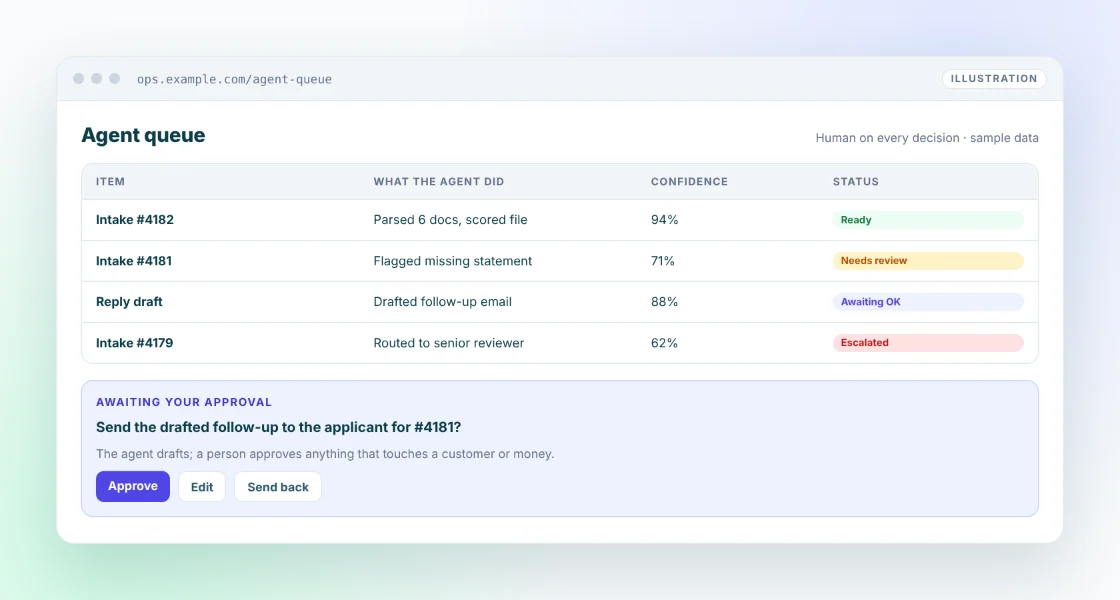
Agents, copilots, and workflows wired into the CRM and operations your team already runs on. Human in the loop on every decision an AI touches. Not chatbot theater.
3. AI Enablement
Team training, SOPs, and guardrails so the systems get used after we leave. Adoption is part of the build.
AI Enablement Program — fixed scope, from $7,500. For teams that want to run AI themselves: training sessions for your team, playbooks and SOPs, governance guardrails (human-in-the-loop rules, data handling practices), and a prioritized build roadmap you execute internally. Every program ends with the roadmap — and we're here if you want help executing it.
Start here: AI Adoption Audit
AI Adoption Audit
A scoped diagnostic of where AI actually pays back in your workflows — with hour and dollar estimates, an honest account of why previous attempts didn't move the needle, identification of data and process prerequisites that are missing, and a prioritized build roadmap with fixed pricing.
Proof
AI operations · Named case
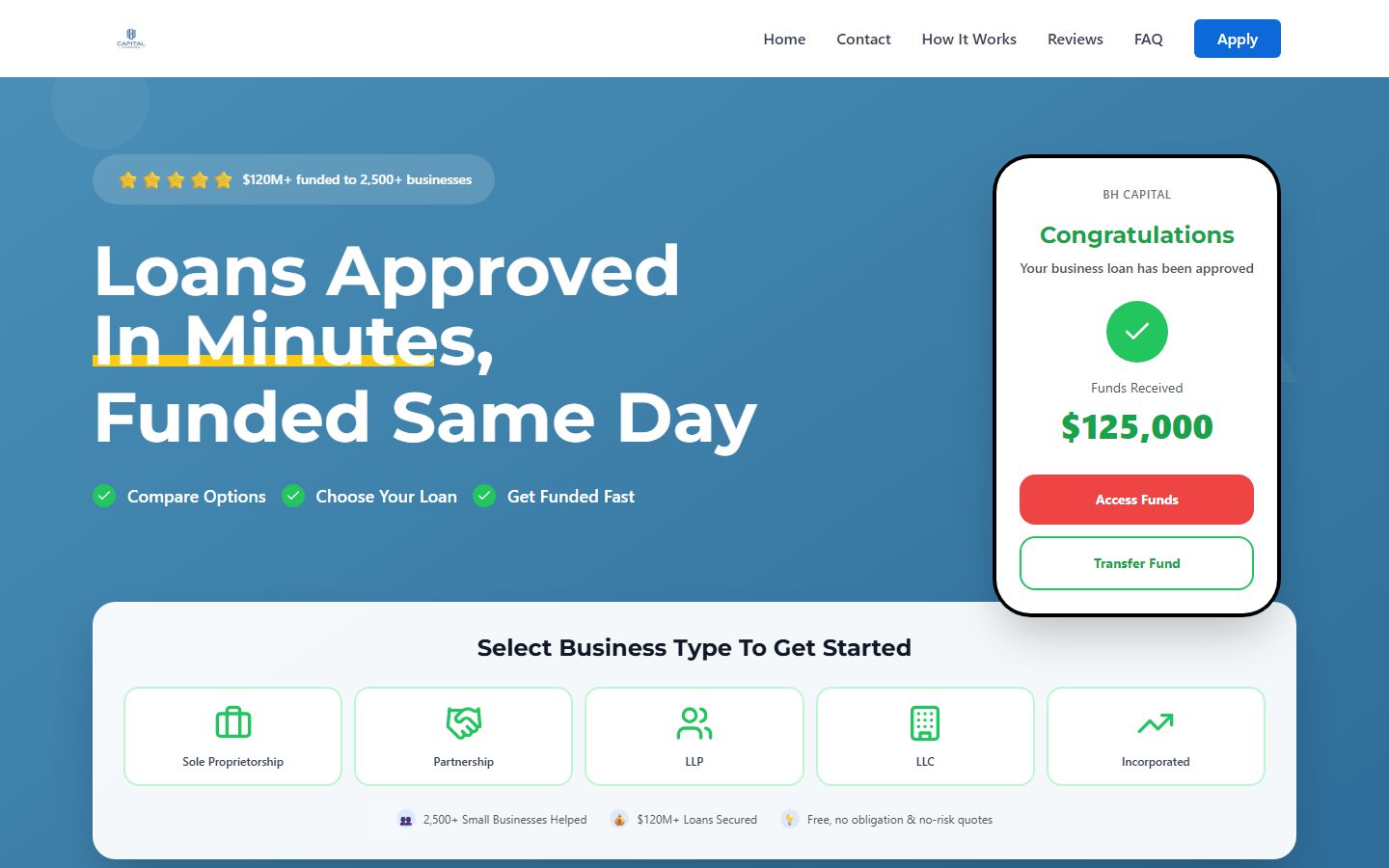
BH Capital Funding: AI underwriting engine
An AI underwriting engine wired into the funding workflow: intake, parse, score, route, package, submit, track. 30 → 5 minutes per file, approvals in 2–3 hours, about 35% fewer declines.
Daniel Speiss co-founded BH Capital Funding. Metrics are operator-reported.
Is this the right fit?
Signs you need it
- You've tried AI tools and seen nothing move in revenue, hours, or error rates.
- A repetitive, rules-based process is eating your team's time.
- AI gets talked about in your business but never gets built into the operation.
- You want AI applied to operations, not a chatbot on a website.
What changes
- Repetitive, rules-based work runs automatically — your team handles exceptions.
- Follow-up and routing happen without manual intervention, with humans on the decisions that matter.
- Internal knowledge is accessible in seconds, not buried in files and inboxes.
- AI adoption sticks because training and guardrails are part of the build.
AI operations: questions answered
What is AI operations, and how is it different from a chatbot?
AI operations means wiring AI into the actual work your team does, not bolting a chatbot onto your website. A chatbot answers questions in a box. AI operations sits inside a workflow: it reads a file, drafts a reply, updates the CRM, routes the next step, and reports on what happened, with a human reviewing anything high-stakes. The value is operational, the manual file review, the copy-paste between tools, the follow-up that slips, not a friendly widget. We ground it in your real business knowledge, add review checkpoints, and connect it to the systems you already run on. At BH Capital, that approach cut underwriting review from 30 minutes to 5 per file. See /solutions/ai-operations/ , or start with a Free Business Checkup .
Do you build AI agents and internal copilots?
Yes. We build custom agents and internal tools that take a whole job off your team's plate, not generic assistants. An agent might intake a document, parse it, score it against your rules, route it, package the result, and track status, the same pattern we built for BH Capital's underwriting engine, which moved approvals from days to 2-3 hours. We scope the business logic first, then build with engineering depth underneath: Tal runs cloud automation in AWS Lambda and Step Functions, plus webhooks, OAuth, and Stripe where needed. Every agent ships with human-approval loops and guardrails on anything customer-facing or high-stakes. We start with an AI Adoption Audit so we build the agent that pays off, in the right order. Details at /solutions/ai-operations/ ; book scoping at /book/ .
Can you train our team to use AI?
Yes. Team training is a real rung on how we engage, not an afterthought. After an AI Adoption Audit, we often build a prompt system and train your people to use it, so AI becomes part of how the team works rather than a tool a few power users poke at. That means prompt systems grounded in your actual business knowledge, clear guidance on where AI helps and where a human still decides, and the judgment to keep people on the high-stakes calls. You do not need an engineer on staff to get value, that is the point of the training rung. It also pairs naturally with the role clarity and delegation work inside Fractional Ops at /fractional-ops/ . See the full AI Operations offer ladder at /solutions/ai-operations/ .
Do you build context databases or MCP-style workflows?
Yes. Most AI fails because it has no grounding in your business, so it guesses. We build business knowledge bases, context databases and prompt systems grounded in your real processes, policies, and data, so AI answers and drafts from what is actually true about your company. From there we connect those knowledge sources into workflows: the AI reads context, takes an assisted step, hands off to a human for review, then updates the CRM and reporting. On the engineering side, Tal works with webhooks, OAuth, and cloud automation in AWS Lambda and Step Functions to wire these pieces together cleanly. Clean, well-structured data is the foundation, which is why this often overlaps with our data work at /solutions/data-analytics/ . See /solutions/ai-operations/ for the build pattern.
How do you keep AI workflows accurate?
Three ways, and none of them is hope. First, grounding: we build knowledge bases and prompt systems tied to your real business knowledge, so the AI is not inventing answers from thin air. Second, human-approval loops: review checkpoints and guardrails sit on anything customer-facing or high-stakes, so a person signs off before it goes out. Third, reporting: the workflow records what it did, so you can see and audit the output, not trust a black box. We also build sandbox-to-staging-to-production discipline, so changes are tested before they touch live work. The goal is your team handling exceptions and decisions while routine work runs itself, with humans on the calls that matter. See how the flow works at /solutions/ai-operations/ .
Will AI replace our team?
No, and we would not pitch it that way. Our model is human-in-the-loop at every rung: AI takes the repetitive, rules-based work off your team's plate so people handle exceptions and decisions, not every case. At BH Capital, AI underwriting cut review time per file, which freed underwriters to focus on judgment calls, not to remove them. We deliberately keep humans on anything customer-facing or high-stakes through review checkpoints and approval loops. The honest framing is capacity, not headcount: repetitive work runs itself, follow-up stops slipping, and your team gets hours back for the work that actually needs a person. If anything, this pairs with clearer role design, which Fractional Ops handles at /fractional-ops/.
What does managed AI operations mean?
AI workflows are not set-and-forget. Models change, your business changes, and edge cases surface once real work runs through. Managed AI operations means we run and improve your AI workflows on a retainer, monitoring accuracy, tuning prompts and knowledge bases, handling new edge cases, and adjusting as models and your needs evolve. It is the difference between a build that quietly degrades and one that keeps earning. This works the same way as our broader fractional model, capacity-capped retainer tiers so we protect quality rather than overcommit, which you can read about at /fractional-ops/ . Many clients start with a build and stay on a retainer to keep it sharp. See the managed rung on the AI Operations ladder at /solutions/ai-operations/ , or book scoping at /book/ .
What does AI Operations cost, and where should we start?
AI Operations packages start at $7,000, scoped by the number and complexity of workflows you automate, with an Embedded AI Engineer available on retainer from $5,000 a month. You do not have to commit to the full thing up front. It is an offer ladder: start with an AI Adoption Audit to see what is worth building, then climb as far as it earns, prompt system and team training, an AI workflow build, an agent or internal tool, then managed operations. If you would rather pressure-test the whole picture first, a Deep-Dive Audit (from $3,500) is credited toward a build that starts within 60 days. The cleanest starting point is a free scoping call where we map what to build and in what order. Pricing detail at /pricing/ ; book at /book/ .
Ready to scope it?
Book a scoping call and we'll map exactly where AI pays back in your operation, in what order, and what it costs.
Is your data AI-ready? Check your Systems & Data readiness →
Packaged builds, with single agents from $3,200. Scoped by the number and complexity of workflows automated and the data-readiness work required. Need it run, not just built? An Embedded AI Engineer stays on retainer from $5,000/mo. Every engagement starts with a scoping call and a written plan.
See all pricing →