CRM builds and migrations, by an engineer.
You’re paying for an enterprise CRM and getting an expensive contact list. The platform isn’t the problem — the build is.
The problem
Most Salesforce orgs are half-configured, ignored by the team, full of bad data, and impossible to forecast from. Past the point-and-click ceiling, you need real engineering: custom objects, Apex, SOQL, and Flows that match how your business actually runs.
What we build
Architecture & configuration
Objects, fields, and automation designed around how your business runs.
Apex / SOQL / Flows
The custom logic standard config can’t handle, built and tested properly.
Migration without losing history
Data moved and cleaned from your old system, history intact.
Integrations & adoption
Billing, marketing, and support wired in; dashboards and training so the team uses it.
Is this the right fit?
Signs you need it
- You’ve outgrown a simple CRM.
- You’re migrating to Salesforce.
- You have Salesforce and it’s a mess.
What changes
- Reflects reality. Your team works in it, not around it..
- Trustworthy forecasts. Clean pipeline data leadership can actually steer by..
- Real engineering. Apex/SOQL depth, not a clicks-only setup..
- Cleaner records
- Fewer duplicates
- Reports leadership can trust
- Reps know what to update
Why us specifically
Our engineer Tal builds Salesforce at the Apex/SOQL level — Flows, triggers, and integrations included, with the Salesforce and revenue-operations work led by a Salesforce-certified RevOps leader who has run revenue systems at enterprise scale across multiple M&A integrations. We’ve done Salesforce architecture and activity hygiene for capital-firm sales orgs, where clean data and trustworthy pipeline reviews directly affect revenue.
Engineering depth under the hood
CRM engineering
Integration layer
Proof
CRM + Migrations · Anonymized
Salesforce activity hygiene and call logging
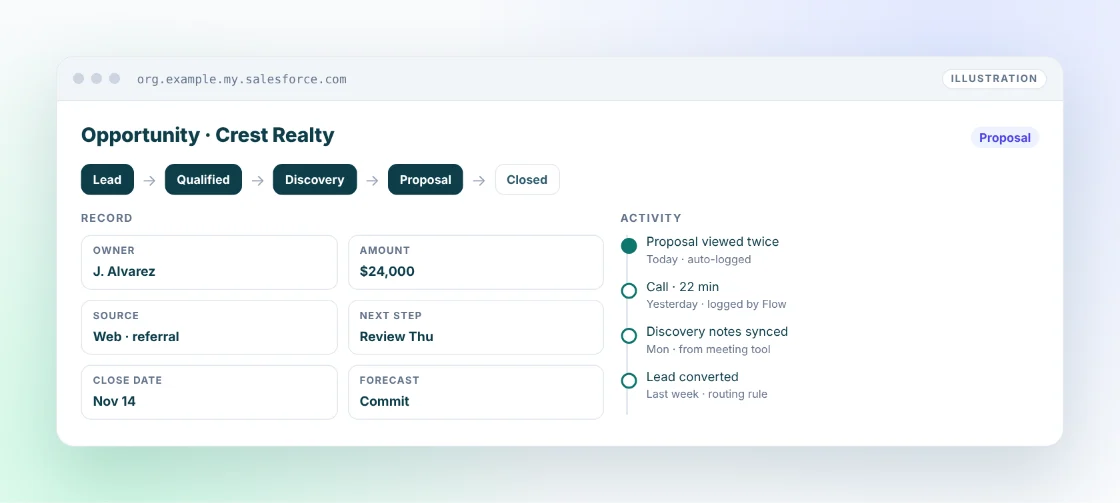
Mislogged call types and stale activities made pipeline reviews unreliable. We corrected the activity data and added weekly hygiene reporting so leadership could trust what the pipeline showed.
CRM and migrations: questions answered
Do you actually work in Salesforce, or just the easy CRMs?
Yes, Salesforce is a core part of what we do. Our engineer Tal builds at the Apex, SOQL, and Flows level — custom objects, triggers, validation rules, and integrations — not just point-and-click config. That matters once you pass the standard-setup ceiling and need logic that matches how your business actually runs. We've done Salesforce architecture and activity hygiene for a capital-firm sales org, where clean data and trustworthy pipeline reviews directly affected revenue. We also work in other CRMs like HubSpot, so we'll be honest about which platform fits your size and budget rather than pushing Salesforce by default. See /solutions/salesforce/ , or book a scoping call at /book/ to map the work.
Can you fix a CRM that's already a mess?
That's one of the most common reasons people call us. Most orgs we inherit are half-configured, full of duplicate or stale data, and ignored by the team because nobody trusts what's in there. We start by diagnosing what's broken — bad records, dead fields, automation that fires wrong — then rebuild the architecture so the system reflects reality and your team works in it, not around it. Clean data is the foundation for forecasting and reporting, which we treat as part of Data Analytics + Revenue Intelligence . A Free Business Checkup or Deep-Dive Audit (from $3,500, credited toward a build within 60 days) is usually the right first step before we touch anything.
HubSpot vs Salesforce — which should we use?
It depends on your size, sales motion, and how much custom logic you need. HubSpot is faster to stand up and easier for small teams to adopt; Salesforce gives you deeper customization through Apex, SOQL, and Flows once your process outgrows simple pipelines. Neither is automatically right. We've built and fixed both, so our recommendation comes from what your business actually needs — not a referral fee. If you're early and lean, forcing Salesforce can mean paying enterprise prices for a contact list. If you've outgrown a simple CRM, Salesforce earns its keep. Bring us the question in a scoping call at /book/ and we'll give you a straight answer before you commit to either platform.
Can you manage our CRM after it's built, or just build it and leave?
Both — and managing it afterward is the point. Our model is "start with a build, stay on a retainer." Once the system is live, we keep it healthy: data hygiene, new fields and automation as your process changes, integrations that break, and reports leadership can steer by. That ongoing work lives under Fractional Ops / Managed RevOps , with Care Plan ($500–$1,500/month), Managed RevOps (from $3,600/month), and Strategic Operating Partner (from $6,000/month) tiers (capacity-capped, scoped to your needs). The alternative — a great build that drifts back into a mess because nobody owns it — is exactly what we're trying to prevent. We document everything via Loom and written handoff so you're never locked in, whether you keep us on retainer or run it yourself.
How do you handle a CRM migration without losing our history?
Carefully, and with a plan you sign off on first. We map your old system's objects and fields to the new structure, clean the data as it moves, and preserve history — past activity, notes, deal records — so nothing critical disappears. Tal works through a sandbox-to-staging-to-production process, so migrations are tested before they touch your live data. We scope migration volume up front because that's a big driver of cost and timeline. The goal is a system your team trusts on day one, not a fresh org missing the context that runs your relationships. Salesforce migrations and CRM-to-CRM moves both fall under /solutions/salesforce/ . Start with a scoping call at /book/ so we can size the data and risks honestly.
We're migrating to Salesforce for the first time — where do you start?
We start with architecture, not data dumping. Before anything moves, we design the objects, fields, and automation around how your business actually runs — your sales stages, your ownership rules, your reporting needs. Building that structure right is what separates a CRM your team uses from an expensive contact list. From there we migrate and clean your existing data, wire in integrations (billing, marketing, support), and add dashboards plus training so the org gets adopted instead of ignored. A first Salesforce build is typically scoped by org complexity, custom logic, and migration volume. We'll lay out exactly what to build, in what order, and what it costs in a scoping call at /book/ — see /solutions/salesforce/ for the full picture.
What kinds of custom logic can you build that standard Salesforce config can't?
Anything past the point-and-click ceiling. When validation rules and standard automation can't express your process, we build Apex triggers and classes, SOQL queries, and Flows that handle the real complexity — multi-object logic, conditional routing, calculated fields, and tested edge cases. On the integration side, Tal wires Salesforce to other systems with webhooks, OAuth, and portal sync, so billing, marketing, and support data flow without manual re-entry. This is real engineering, written and tested properly, not a clicks-only setup that breaks under load. It's the same depth we apply across App + Internal Tool Development . If you're hitting limits in your current org, a scoping call at /book/ will tell you what's possible and what it takes.
How does CRM work connect to the rest of what OpsPal does?
Your CRM is the spine of your revenue operation, so we rarely treat it in isolation. A clean, well-architected CRM feeds trustworthy dashboards and forecasting under Data Analytics + Revenue Intelligence , supports the pipeline and process design in Revenue Operations , and gives operational AI — agents, AI-assisted follow-up with human approval — clean data to act on under AI Operations . We follow one method across all of it: Diagnose, Architect, Build, Run. So a Salesforce or HubSpot build isn't a one-off; it's the foundation other systems plug into. If you're not sure where to start, the Free Business Checkup will show which piece to fix first.
Ready to scope it?
Book a scoping call and we’ll map exactly what to build, in what order, and what it costs.
Not sure where your CRM stands? Run the 2-minute Sales System check →
From a data hygiene sprint to a full build-out or complex migration. Priced by the objects we build or move, custom logic, and record volume.
See all pricing →