Pipeline, scoring, and reporting you can steer by.
Your revenue data is scattered, your pipeline is a guess, and reporting is stale by the time you read it.
The problem
When leads, deals, and activity live in different tools with no shared definitions, you can’t forecast, prioritize, or coach. RevOps is the connective tissue: clean stages, scoring, routing, and reporting that reflect reality.
Read the rules we actually build: Speed to lead is not a metric. It is a system, and most teams are winging it.
What we build
Pipeline & stage design
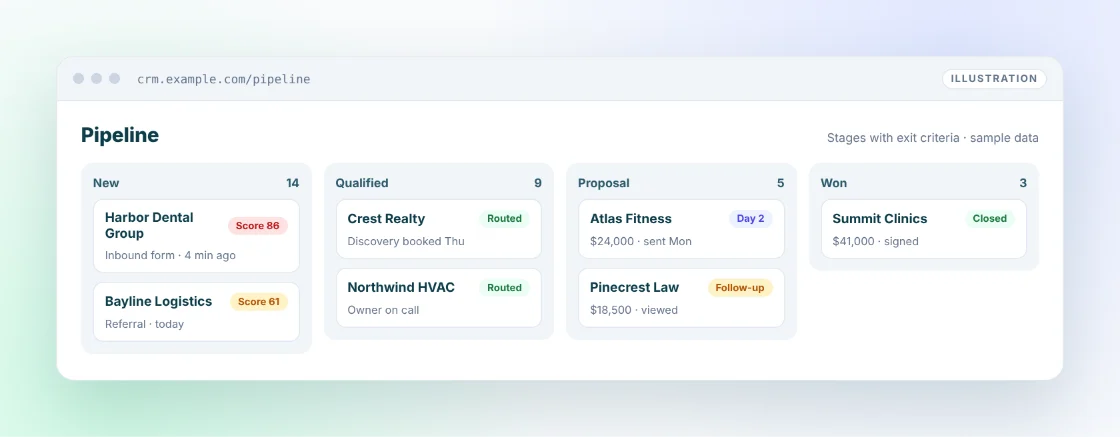
Stages, definitions, and exit criteria your team actually follows.
Lead scoring & routing
The right leads to the right reps, fast.
Follow-up automation
Sequences and reminders so nothing high-intent goes cold.
Reporting & forecasting
Dashboards tied to current reality, not last month’s export.
Is this the right fit?
Signs you need it
- You can’t forecast from your CRM.
- Leads sit before anyone works them.
- Reporting is manual and always behind.
What changes
- Trustworthy pipeline. Forecasts grounded in clean data.
- Faster response. High-intent leads worked in minutes.
- Real numbers. Reporting current enough to act on.
- Faster follow-up on inbound leads
- Fewer stale deals in pipeline
- Clearer view of where revenue stands
- More complete sales tasks and follow-through
Why us specifically
Daniel ran sales floors and revenue operations inside a finance business — he scopes RevOps from the operator’s seat, not a template. The RevOps and Salesforce delivery is led by a Salesforce-certified revenue-operations leader who has built and led revenue systems at enterprise scale across multiple M&A integrations. Tal builds the CRM, scoring, and integration logic underneath. We’ve delivered speed-to-lead, attribution dashboards, and forecast reporting for founder-led capital firms.
Engineering depth under the hood
Integration layer
Proof
Revenue operations · Anonymized
Speed-to-lead intake after applications
Post-application response time was measured in hours. After automating redirect, intake and routing, high-intent inbound reaches sales in minutes.
Revenue operations: questions answered
What does RevOps actually mean for a small or mid-sized business?
For an SMB, RevOps isn't a department you hire — it's the connective tissue between your leads, deals, and reporting so the whole revenue motion runs on one shared system instead of guesswork. In practice that means clean pipeline stages with real exit criteria, lead scoring and routing, follow-up that doesn't let high-intent leads go cold, and dashboards that reflect current reality rather than last month's export. The goal is plain: a pipeline you can forecast from and numbers you can act on. We scope it from an operator's seat, not a template — Daniel ran sales floors and revenue operations inside a finance business, and Tal builds the CRM, scoring, and integration logic underneath. See /solutions/revenue-operations/ , or start with a free Business Checkup .
How do you design a pipeline our team will actually follow?
Most broken pipelines aren't a tooling problem — they're a definitions problem. When "qualified" means something different to every rep, the forecast is fiction. We design stages around how your business actually sells, each with clear entry and exit criteria so moving a deal forward is a fact, not an opinion. We keep the number of stages honest, strip out fields nobody fills in, and automate updates where we can so logging isn't a chore. The test we care about is adoption: if reps work around the pipeline in spreadsheets, the data rots and the forecast stops meaning anything. So we build it with the team that uses it, not for an idealized process. This usually ships inside a RevOps build. See /solutions/revenue-operations/ or our method .
How do you improve lead scoring, routing, and speed-to-lead?
Speed-to-lead is often the cheapest revenue win available, because high-intent leads go cold fast when they sit in a queue. We build the path end to end: capture the lead, score it so the best ones surface, route it to the right rep automatically, and trigger follow-up sequences and reminders so nothing slips. The aim is high-intent leads worked in minutes, not hours. Under the hood Tal wires the integration layer — webhooks, OAuth, CRM sync — so routing fires the moment a lead arrives instead of waiting on a manual check. Scoring and routing rules reflect your real territory, capacity, and ownership logic, not a generic round-robin. This typically ships as part of a RevOps build. See /solutions/revenue-operations/ or book a scoping call . The rules we actually build are in Speed to lead is a system, not a metric.
Can you build forecasting from our CRM that we actually trust?
Yes — but trustworthy forecasting depends on clean stages and clean data underneath, so we usually fix those first. The problem with most SMB reporting is that it's manual, always behind, and built on stages nobody applies the same way, so the forecast is really a guess wearing a chart. We design stages with clear exit criteria, then build dashboards tied to current reality instead of a stale export, so leadership can steer by the numbers, spot what's slipping, and coach reps on live data. We've delivered attribution and forecast dashboards for a founder-led capital firm so capital and ops decisions tracked current revenue, not last month's. Deeper attribution and forecasting work lives under /solutions/data-analytics/ ; the pipeline foundation is part of a RevOps build. See /solutions/revenue-operations/ .
How do you get sales and marketing operations on the same page?
Misalignment usually isn't a people problem — it's that sales and marketing run on different definitions and disconnected tools, so leads get argued over instead of worked. We start by agreeing on shared definitions: what a lead is, when it's qualified, who owns it at each stage, and what "closed" means. Then we wire the systems so a lead captured by marketing flows into the CRM, gets scored, and routes to sales without a manual handoff that drops things. One source of truth means both teams read the same pipeline and the same numbers, so the handoff stops being a black hole. Daniel scopes the ownership and process; Tal builds the integration underneath. This sits inside a RevOps build — see /solutions/revenue-operations/ , with process ownership alongside it.
Our pipeline data is a mess. Can you fix it without a full rebuild?
Usually, yes — a rebuild from scratch is rarely the right answer. Most messy pipelines are half-configured, full of inconsistent stages and bad records, and quietly ignored by the team. We start with a Deep-Dive Audit to map what's salvageable, then fix stages and fields, dedupe and clean records, wire up the routing and follow-up that's missing, and add validation rules so it stays clean at entry. History stays intact. Clean data is the foundation everything else sits on, which is why hygiene and the guardrails to hold it live under /solutions/data-analytics/ . The audit runs from $3,500 and is credited toward a build that starts within 60 days. RevOps builds are scoped by CRM complexity and the number of revenue workflows — see /solutions/revenue-operations/ and /pricing/ .
Do we need a full-time RevOps hire, or can you run this for us?
Most SMBs don't have enough steady RevOps work to justify a senior full-time hire, but they do need senior-level ownership. That's the model we're built for: start with a build, then stay on a retainer to run and evolve the system. After we ship the CRM, scoring, routing, and reporting, a managed retainer keeps it healthy — handling changes, watching data quality, and adding workflows as you grow. Retainers start at $3,000/month, scoped by operating load, meeting cadence, and how much systems responsibility you want us to carry. You get a CRO/COO-level operator plus an integration engineer instead of one generalist hire, and we work remotely across US markets. If you mainly need fractional ownership of ops, see /fractional-ops/ ; pricing detail is at /pricing/ .
How long does a RevOps build take, and what does it cost?
It depends on scope, but the process is consistent. We follow the OpsPal Revenue Operating Method: Diagnose, Architect, Build, Run, with an optional Scale phase later. We usually start with a Deep-Dive Audit (from $3,500, credited toward a build that starts within 60 days) to map the current state and the order of work. Then we architect the system, build in sprints with weekly demos, and hand off cleanly with dashboards, runbooks, and a Loom walkthrough. A focused Build Sprint starts from $5,000; RevOps packages start at $7,500 depending on CRM complexity and the number of revenue workflows. You'll see a clear sequence — what to build, in what order, and what it costs — before you commit. See /method/ and /pricing/ , or book a scoping call .
Ready to scope it?
Book a scoping call and we’ll map exactly what to build, in what order, and what it costs.
Not sure where you're leaking? Find your biggest revenue leak →
Three packages, from RevOps Starter to RevOps Pro, scoped by CRM complexity and the number of revenue workflows. Managed RevOps after the build from $3,600/month.
See all pricing →